


 My Cart 0

What happened?
US stocks dropped briefly last week after news broke that US President Joe Biden is looking to almost double capital gains tax rate for the rich (those earning $1 million or more) to 39.6% from the current base rate of 20%. The increase would equalize the tax rate between wage and capital gains (Current capital gain tax is 23.8%- 20% base rate + 3.8% net investment income tax vs current highest wage tax bracket of 37%).
The proposal has not been officially announced but according to reports, President Biden is likely to release the details in a joint address to Congress on April 28, along with details of the American Familes plan.
Any hike in taxes however would have to go through US Congress, where Democrats currently hold a narrow majority.
Putting into perspective

Source: JPM Cross-Asset
If passed, the capital gain tax will be the highest tax rate paid on investment gains (mostly by wealthiest Americans), where the rate has not been higher than 33.8% since World War II.
What others are saying
UBS: Only 25% of US equities are owned by US taxable investors, with the remaining held by those not subjected to the capital gains levies. Expect a buy on dip by investors who are not affected which may lend support to share prices.
Goldman Sachs: Past capital gains tax hikes have resulted in some short term declines in equity prices. However, the trend of selling and falling stock prices are usually short-lived, reversing in subsequent quarters.

Source: Goldman Sachs
Join our Telegram, Instagram, Facebook and Linkedin.
What happened in markets this week, and what are analysts talking about?


Sembcorp Industries

• Credit Suisse: Initiate coverage on SCI with an OUTPERFORM rating and TP of S$2.40, based on Sum of the parts valuation implying ~1.2x FY21F P/B. SCI is shifting to renewables as it looks to grow its renewables capacity to 4,000MW (31% of its energy portfolio) by 2022 from its current ~3,300MW. According to Credit Suisse, SCI may have room to re-rate as it is trading at 0.9x P/B vs its renewable energy peers of more than 3x P/B, if SCI is able to successfully grow its renewables portfolio.
•HSBC: Upgrade SCI to BUY from HOLD, with an increased TP of $2.61 (implied 2021F P/B of 1.3x) from $1.68. HSBC now values the energy division of SCI at 8x 2021F EV/EBITDA (from 7x previously), a slight premium to the FY2021F market cap-weighted EV/EBITDA of its peers (excluding outliers) to account for SCI being the only Singapore based energy company listed on STI.


Dairy Farm International
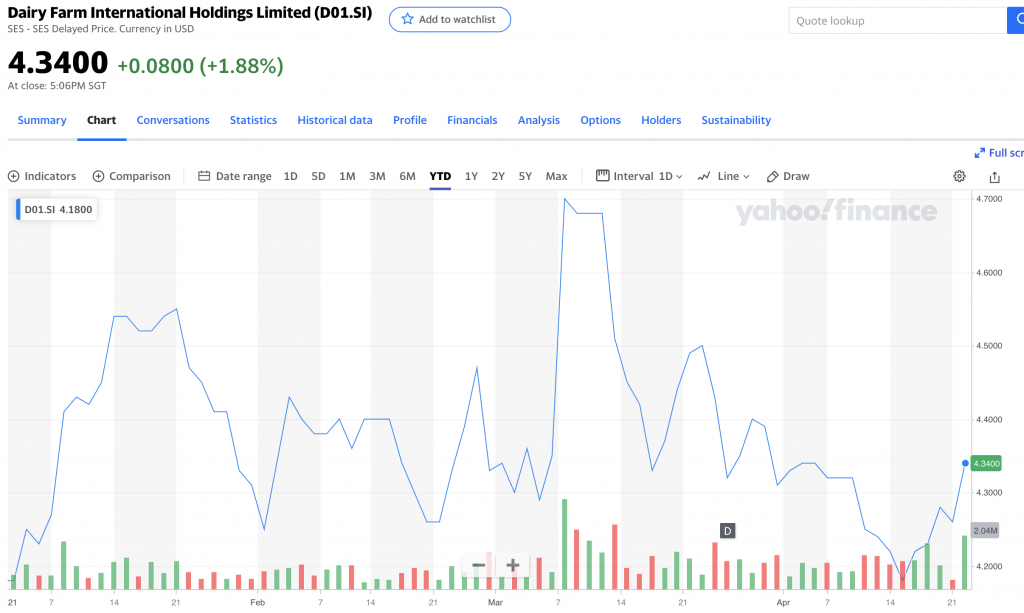
• UOB: Initiate coverage on Dairy Farm International (DFI) with a BUY and TP of $5.19. Sees DFI as a play on Asia’s developed and emerging markets with its multiyear strategic transformation since 2018 having led to higher EBITDA margins. DFI is the largest retailer in Asia ex-Japan with a strong market presence in China, HK, Taiwan, India and ASEAN. DFI’s PE is 1SD below its 5 year average which the house thinks is undervalued due to the Group’s stable platform as the economies in the region recovers and earnings growth over the next few years.

Thai Beverage
The proposed spinoff of Thai Beverage’s beer business has been deferred due to uncertain market conditions and volatile outlook. Beerco, ThaiBev’s subsidiary, has 3 breweries in Thailand and interest in 26 breweries in Vietnam.

• UOB Kayhian; Lucas Teng: Thai Bev remains attractively priced at 17x FY21F PE, -1SD to its average PE. The Group’s core spirits business continues to show resilience, with majority off-trade sales. The house recommend accumulating on weakness
• Maybank, Kareen Chan: Stock is trading at 15x FY21F PE, -1SD below 5 year mean and 65% discount to its peers of 45x. The house noted the increased risk for Thaibev due to the resurgence of COVID-19 in Thailand and Vietnam, as well as the absence of a catalyst from the potential spinoff. However, the house believe share price may be supported by attractive valuation
For our more info on markets and access to stock research, pls open a trading account with our preferred broker or subscribe to us. PM @moneyplantt at Telegram or email us at connect@gem-comm.com
Join our Telegram, Instagram, Facebook and Linkedin.
What happened?
Bitcoin saw a massive sell-down over the weekend, plunging more than 12% – the biggest intraday drop since February 2021. While Bitcoin crawled back part of its losses, the cryptocurrency was still down more than 10% from its high of nearly US$65,000, at about US$57,000 as at time of writing. At one point, according to crypto-data website, coinmarketcap.com, Bitcoin and the global crypto market lost more than US$200 billion and US$350 billion in market cap respectively.
1 month market capitalization of Bitcoin (USD)

1 month market capitalization of global cryptocurrencies

Why did it happened?
The fall came on the back of news citing that the US treasury intends to investigate financial institutions conducting money laundering through digital assets. The crash was also attributed to a blackout at China’s Xinjiang which powers a huge number of Bitcoin miners, resulting in about half of the Bitcoin network to go offline in 48 hours according to Coinmarketcap.com.
As the frenzy in cryptocurrency rises, it has also unnerved some investors and authorities. According to a Bank of America survey, nearly 3 in 4 professional investors see bitcoin as a bubble, with fund managers rating bitcoin second on the list of being the most crowded trades. Turkey’s central bank had also ban cryptocurrency payments last week citing excessing volatility and a lack of regulation. This echoes similar concerns from other central governments including US Fed Chairperson Jerome Powell who has cautioned over Bitcoin investments, pointing out that it may not serve as an effective store of value as these so-called currencies are not “backed by anything”.
Nonetheless the global cryptocurrency market and bitcoin has continued to trend higher this year, with their market cap doubling year to date, as more investors pour into the market and companies starting to lend their support for the cryptocurrency market helping to bring it mainstream.
What do you think about the Cryptocurrency market now? Let us know in the comments section below!
Join our Telegram, Instagram, Facebook and Linkedin.
What happened in markets this week, and what are analysts talking about?

Alibaba Group
China authorities imposed a record antitrust fine of US$2.8 billion on Alibaba Group, representing 4% of the Group’s 2019 revenue. This is triple of the previous US$975 million fine by Qualcomm in 2015, but far less than the maximum 10% allowed under Chinese law.

• Bloomberg: Fine may lift the regulatory overhang that has weighed on the company since late December 2020. Alibaba may have to be conservative with acquisitions and broader business practices.
• Morgan Stanley: Fine represent 6% of Alibaba’s current net cash and 0.5% of its market cap. The regulatory decision should lift a major overhang on the stock and the decision come without Alibaba having to make significant structural or asset divestures which may affect its core competence.
• Nomura: Fine while painful is a manageable one off expense for Alibaba. Conclusion of the investigation allows the Group to move on from the regulatory turmoil and recast the focus back to its business. Believes Alibaba is one of the cheapest big cap names in China’s internet space and the current risk reward looks attractive.

Frasers Logistics & Commercial Trust
Frasers Logistics & Commercial Trust (FLCT) has been included in STI from 13 Apr 2021. According to CIMB, they estimate FLCT’s weight in STI to be about 1.14%.

• CIMB; Lock Mun Yee and Eling Kar Mei: High conviction call, as they like FLCT’s “visible inorganic growth potential and income resilience, backed by a long WALE (weighted average lease expiry) profile.” CIMB likes FLCT for its stable portfolio which is supported by its robust industrial segment underpinned by pick-up in economic activity and a stable commercial segment as Singapore ease workplace restrictions. BUY recommendation with target price of S$1.57.

Jiutian Chemical
Prices of Dimethylformamide (DMF) has been on strong uptrend year to date (gaining about 40% year to date) in China. Jiutian is the second largest DMF producer in China. Jiutian also produces methylamine, together with DMF, these chemicals are used in various industries including consumer goods, petrochemicals etc.
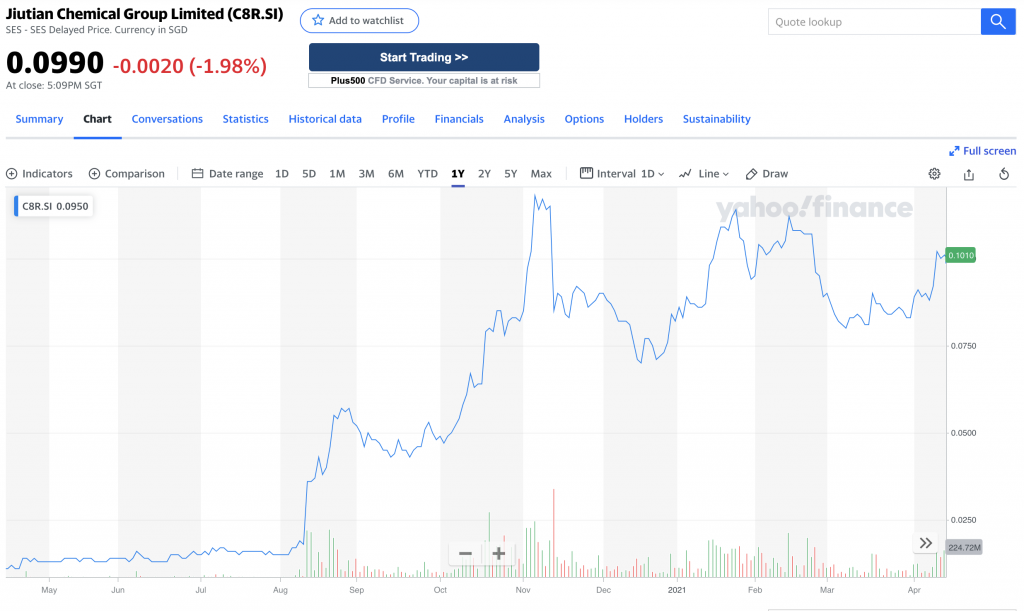
• CIMB; Ong Khang Chuen and Kenneth Tan: 1Q21F earnings preview- expect another quarter of record profits with core net profit of RMB78.5m (>28x increase yoy). Reiterate Add, as expect Jiutian to enjoy strong earning in 1H21F, and valuations being attractive at just 3.9x FY22F PE, backed by net cash of RMB110m as of end FY20 (about 11.6% of current market cap)
• KGI: Robust selling price of DMF may hint of upcoming 1Q21F results being a catalyst for the company, as Jiutian is scheduled to report in last week of April.
For our more info on markets and access to stock research, pls open a trading account with our preferred broker or subscribe to us. PM @moneyplantt at Telegram or email us at connect@gem-comm.com
Join our Telegram, Instagram, Facebook and Linkedin.
We all know what went down in 2020.
The world got hit with a pandemic, and global economic and trade was severely disrupted. The 2020 economic outlook took a sharp turn, and stock markets crashed globally.
There were many reports about the 2020 stock market crash all across social media back then. Even if you were not a finance junkie at all, you would have felt the effects of the stock market crash.
But what exactly is a stock market crash? Does it affect our everyday financial health? Is it the end of the world?
What is a stock market crash?
A stock market crash can be defined as a sharp drop in prices of stocks. Over the years, there have been several stock markets collapses, each with its own unique reason for why it happened.
Instead of worrying endlessly about a stock market crash, it would be useful to study the reasons behind historical market crashes.
We’ve compiled a few of the significant market crashes in the past to give you a glimpse of how things happened, and how the market eventually recovered.
1987 Black Monday Crash
- On 19 October 1987, all the major work markets experienced a sharp decline in price from 20 to more than 40%. The US Dow Jones Index fell more than 20% for the day. Prior to the crash, markets had been on a roar, as the Dow Jones more than tripled in value since 1982, leading to concerns of an overvalued market that was due for a major correction. (FOMO Investors who are at the same time worried about the market’s valuation)
- With market participants mostly jittery about market valuations, it also prompted investors to set “stop-loss orders” (automated orders to sell out of stock positions, if prices dropped to/past a certain point) As the market drop, these stop loss orders further exacerbated the speed and size of the market losses. To make matters worst, large institutional investors also partially hedged their portfolios by implementing portfolio insurance strategies- automatically increase short future positions if there was a significant decline in stock prices.
- Markets only recovered back to levels before the crash in March 1989. (17 months)
Dot-com Bust (2000 – 2002)
- Termed as the internet stock bubble, US tech heavy index, Nasdaq, hit an a high of 5,132 in March 2000. By Oct 2002, the Nasdaq has fallen by more than 70%. Prior to the fall, the Nasdaq rose almost 4x driven by speculation on internet-related companies, as computers became a mass market product.
- Record amount of funds flowed into Nasdaq during the period, as the Fed Chairman then, Alan Greenspan, warned the markets of “irrational exuberance” in 1996. However, he only tightened monetary policy in 2000, bursting the internet bubble.
- It took 15 years for the Nasdaq to rebound back to levels before the crash, in April 2015. (15 years)
11 Sep 2001 Attacks
- On 11 Sep 2001, 2 planes crash into World Trade Center in the US. Stock exchanges including the US and London were closed and evacuated in fear of more terrorist attacks.
- Markets went into risk off mode, with the US Dow Jones index falling more than 7% on the first day of trading, the largest loss in history for a trading then (before the flash crash during COVID-19). At the end of the first trading week following the accident, the Dow Jones was down more than 14%.
- Nonetheless this was a relatively short sell off, as markets subsequently rebounded and was back to the levels before the crash by November 2001. (3 months)
2008 Global Financial Crisis
- Often referred to as one of the most severe financial crises in recent times. The global financial crisis in 2008 was a result of excessive risk taking by banks (in the form of mortgaged backed securities) which threatened the financial system with the collapse of the US housing market. The bankruptcy of Lehman Brothers in Sep 2008 became the trigger for the crisis and the wakeup call to the world. Prior to that, investors have been speculating on the rising US home prices, with home mortgage debt rising from an average of 46% during the 1990s to 73% during 2008. The crisis which started in the US spread rapidly to the rest of the world in part as US accounted for more than a third of the growth in global consumption then, and large financial institutions were also linked due to derivates such as credit default swaps.
- The crisis saw central banks having to unleash huge stimulus to buy up mortgage securities and reduce interest rates to 0%, and to bail out “too big to fail banks”. Following the crisis, it also saw stricter regulations for the large banks including the Dodd-Frank act to ensure the stability of the financial system. Even after more than 10 years from the financial crisis, several banks have not fully recovered their lost market cap including Bank of America and Citibank.
- US markets peaked in Oct 2007 and bottomed only in March 2009. Markets recovered back to levels before the crash in March 2013. (5 yrs 6 months)
2020 Covid-19
- COVID-19 brought about what was believed to be the worst recession since the Great Depression of the 1930s, as the pandemic brought about social distancing measures and lockdowns resulting in a disruption in economic activity. By April 2020, more than 3.9b people or half of the world’s population were ordered to stay indoors to prevent the spread of the virus, with recommended confinements and curfews in more than 90 countries or territories.
- In March 2020, markets around the world suffered one of their steepest and fastest fall in recent times. The US S&P500 index took just 22 trading days to fall 30% from its record high in Feb 19, making it the fastest drop of this magnitude in history. However, as markets grasp with the pandemic, and central governments around the world unleash unprecedented stimulus to boost the economy, markets rapidly rebound.
- After bottoming in March 20, markets recovered back to levels before the crash in November 20 (8 months)
The Money Matters
After the “worst recessions since Great Depression”, markets are looking forward to a global economic recovery. What are the experts saying?
UBS: Long Value over Growth over Defensives. Forecast S&P 500 at 4,100 at end 2021E.
Morgan Stanley Wealth Management: Forecast 10% gain next 12 months, sees opportunity in smaller cap stocks that “have greater sensitivity to what is likely to be a very strong economic recovery, along with financials, consumer services, materials, industrials and cyclical technology stocks”
Locally,
UOB: Sees STI valuation as “not stretched”, 2021 target for STI at 3,180. Overweight Banks, healthcare, plantation, technology and suburban retail and hospitality S-REIT sectors
CIMB: Base case Target for STI for 2021 at 3,068 (Bull at 3,412). Still “bullish on recovery theme but think one should wait for a market breather to reload ammunition.”
January
- WHO announced that COVID-19 had emerged in Wuhan, China, and is spreading across the world.
- Brexit is officially completed- as UK becomes the first country to leave the European Union, after 47 years of membership
February
- Donald Trump was acquitted by the senate for his impeachment
March
- Australia bushfire finally ended– the fire which started from Sep 19 to Mar 20, is estimated to have cost Australia’s economy as high as A$5 billion
- Stock markets crash around the world- US S&P500 took just 22 trading days to fall 30% from its record high, the fastest drop of this magnitude in history.
- Tokyo 2020 Olympics was officially postponed till 2021. As a result of COVID-19, the delay is expected to cost Japan an additional $2.4b, adding to the previous budget of $13b which was already significantly more than originally planned. The delay had caused a surge in extra costs from rebooking venues, transport, to COVID-19 counter measures
- SIA to raise $15b with support from Temasek to combat COVID-19 via shares offering and convertible bonds. Temasek had pledged to underwrite all shares and bonds that are not subscribed. SIA had come under pressure as COVID-19 halted air travel. DPM Heng said “SIA is an outstanding airline and a strategic asset for Singapore. Through the Government’s support for the aviation sector, and if necessary more direct support measures, we will make sure that SIA is able to come through this in good shape.”
April
- Half of the population was under lockdown with more than 3.9b people in more than 90 countries ordered to stay at home. Singapore announced its circuit breaker starting from 7 April 2020, before progressively easing restrictions from 1 June 20.
- US unemployment rate hit a record high of 14.7%, the highest rate and largest over the month increase due to COVID-19.
May
- Black live matters- Protests broke out in US in May, after a Black African American was killed due to a white police officer kneeling on his neck for nearly 8 minutes, as other officers looked on and prevented passers-by from intervening. The protests spread to over 60 countries, and continue well into early November, with some believing it helped to boost the anti-Trump vote.
June
- Wirecard filed for insolvency – In a shock news to the business world, Wirecard filed for insolvency following an accounting scandal which saw over US$2b missing and the arrest of its CEO. It was the first member of Germany’s blue chip DAX index to fail
- China passes controversial HK national security law giving Beijing unprecedented powers over HK. This led to strong responses from overseas which raised concerns that HK’s position as a financial and business hub in Asia may be threatened. US President trump ordered an end to HK’s special status under US law following the passing of the HK national security law.
July
- MAS calls on local banks to cap FY20 dividends at 60% of FY19. This came amidst concerns of the banks financial strength amid the uncertain economic climate, as central governments around the world try to ensure local banks’ capital positions are strong to support businesses and economies. In June, US Fed has also capped US banks dividends and suspended their buybacks
- Facebook suffered ad boycotts which saw over 1,000 companies participated including Unilever and Coca-Cola. The boycott came after Facebook refused to censor a post containing Donald Trump’s “When the looting starts, the shooting starts” as well as a post by Trump that criticized CHAZ, leading to immense criticism.
August
- Singapore reports worst ever quarterly contraction of 13.2% in 2Q20. This was mainly due to the circuit breaker which was implemented from 7 Apr to 1 June.
November
- Joe Biden wins US election – In one of the highest voter turnout in more than a century, Joe biden was voted the next president of USA. He will be the oldest president to ever take office at 78 years old. This is the third time Joe Biden has ran for the White House, having done so previously in 1988 and 2008.
- ANT IPO abruptly halted- In what could have been the world’s largest IPO valued at more than $300b, ANT Group, the financial arm of Alibaba, saw its listing abruptly pulled by Chinese regulatory authorities, citing “major issues”.
- China cracked down on its biggest tech companies in the country as the nation’s biggest tech companies lost nearly $290b in market value in just 2 days (the GDP of Egypt). The selloff came amidst new regulations from Beijing aimed at curbing monopolies in big tech.
- Bitcoin hit a new record high, surging above its last peak reached in Dec 17. Cryptocurrencies has been on a roar in 2020, amidst massive stimulative measures by governments around the world, in a bid to support the world economy.
December
- First COVID-19 vaccines roll out for Americans after the US FDA approved emergency use for Pfizer’s and Moderna COVID-19 shot. Singapore also got its first shipment of vaccines on 21 Dec 20.
- ‘New variant’ of coronavirus found in UK , which PM Boris Johnson said could be “up to 70% more transmissible”
- Tesla joined S&P 500 share index- This follows a nearly 700% rise in share price in 2020. Tesla will become the sixth largest member in the S&P 500 share index.
- Singapore grant digital bank licenses – Grab-Singtel consortium and SEA secured the full digital bank license, while ANT Group and a consortium comprising Greenland Financial Holdings, Linklogis HK and Beijing Co-operative Equity Investment Fund management was granted digital wholesale bank licenses.
- mm2 proposes the merger of its cinema business (Cathay Cinemas) with Golden Village. The move will form the biggest cinema operator in Singapore
- Robinsons closed its last outlet in Singapore. The iconic 162 year old department store closed its flagship store at The Heeren on 16 Dec 20.
For more reports and market insights, pls open a trading account with us (text +65-8740 7951 or PM telegram @moneyplantt)